Home Charging Guide: Apartment, House, and Generator Scenarios
Wiring, permission, and safety for charging where you live. Grid power and generator power are not the same job, and neither is a DIY extension cord.
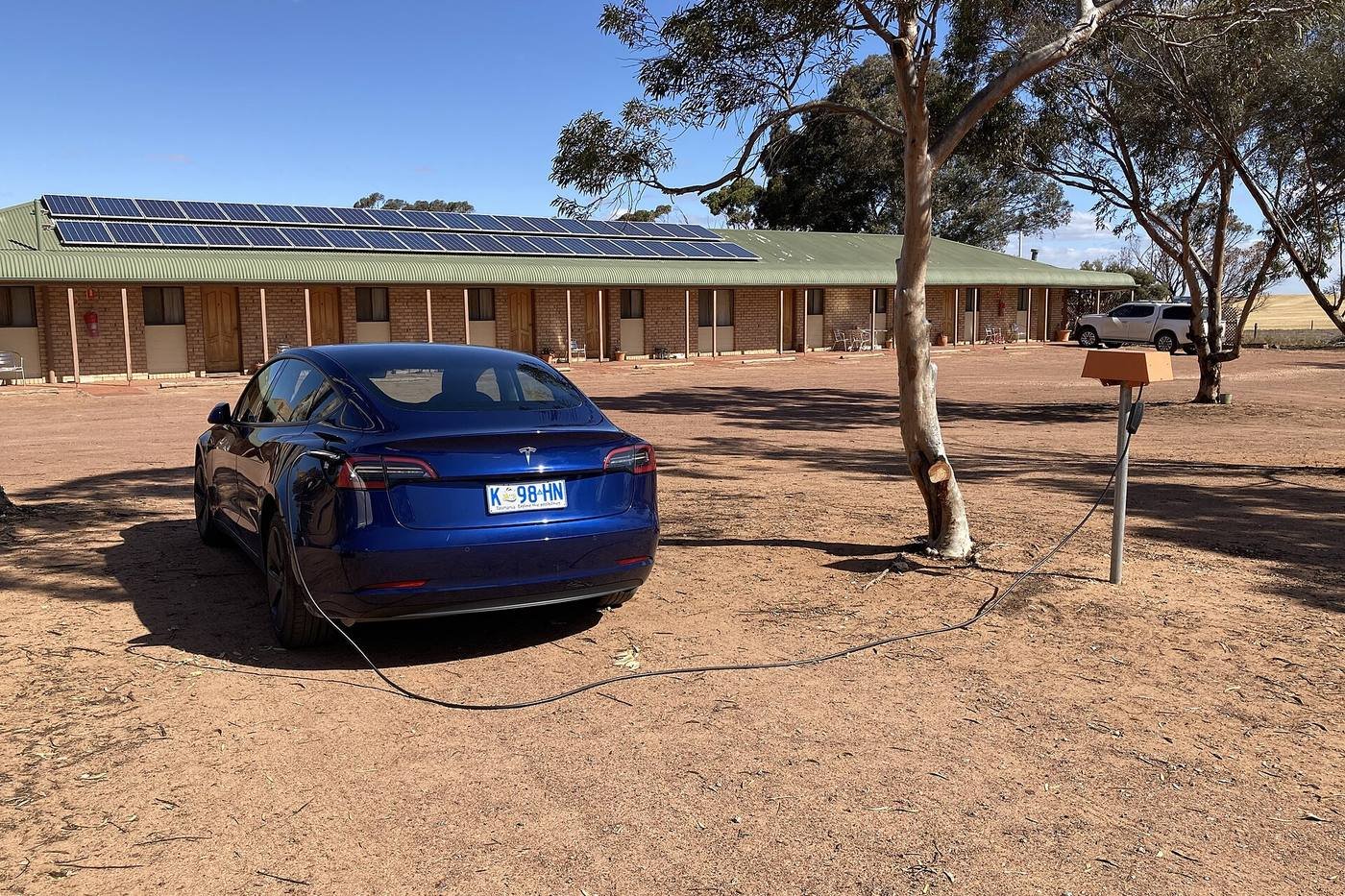
Public chargers in Iraq are too scattered to be your main plan. Home charging is the plan, and home charging is an electrical job. The photo shows a Tesla Model 3 plugged in at an ordinary outdoor site. It is a picture of destination-style charging, not a wiring diagram and not an Iraqi house. Your building, your panel, and your generator are the facts that matter. This article will not quote an installation price or a safe kilowatt figure for every home. Those come from an electrician who has opened your panel.
The rule underneath the three scenarios
A charger wants a dedicated circuit, proper grounding, and protection that matches the hardware. It does not want a multi-plug adapter, a coiled extension reel, or a socket that also runs a kettle and an air conditioner. EV charging pulls a sustained load. Sockets that survive a vacuum cleaner for ten minutes can overheat when they work for hours. If you remember one sentence, remember that an electrician does this, not a video.
Use the cable and wallbox the car's manual allows. Do not buy a no-name unit because the listing was cheerful. If you are in an apartment, you may not be allowed to install anything. Permission is part of the technical job.
House
A house with off-street parking is the simple case. Ask an electrician to inspect the incoming supply, the panel, and the earthing before anyone talks about a wallbox. Tell them what else runs in the evening: AC, a water pump, an oven. A charger that fits on paper can still be wrong if the house is already near the limit of its supply when the AC starts.
The parking place should be close enough for the cable that came with the car, without a join in the middle and without the cable lying across a path where a gate cuts it. Weather protection matters in dust and rain. The connector should not sit in a puddle.
Ask the electrician what protection they will fit, and ask them to label the circuit. When something trips later, you want to know which breaker is the car. Keep their invoice. It is part of the story you will tell the next owner, and it is part of how you show you did not improvise.
If the car's manual describes a charging limit or a schedule, read it. Charging when other loads are lower can be kinder to a weak supply. This guide will not tell you a clock time. Your household knows when the AC and the oven run.
Apartment
Start with permission, in writing if you can. A cable from a window to a courtyard is how neighbors and building managers end a project, and it is how cables get damaged. A designated bay with a socket the building owns is a different conversation from a cable across shared pavement.
Even with permission, the building's riser and your meter may not have spare capacity. The electrician has to see the building side, not only your living room. If the association says no, believe them. A full EV is then a poor fit unless you have workplace charging you control. A plug-in hybrid you cannot plug in is also a poor fit. Read the powertrain comparison and buy the car that matches the building you actually live in.
Shared chargers in a garage need rules: who can park there, how long, and who pays. Those are building rules. They are as important as the hardware.
Generator
Many Iraqi homes already live with a generator for part of the day. Charging a car from that generator is not automatic. Generators differ in size, grounding, waveform, and how angry they get at a long, steady load. Some chargers are picky about power quality. Some generators are a poor match for electronics. The only responsible answer is an electrician who will look at your set and at the charger, and will say yes or no.
Do not test the question by plugging in and hoping the breaker is your safety system. Do not backfeed a panel. People get hurt that way, and the car is not worth it.
If the electrician says the set can support a modest charge rate while the house is otherwise quiet, follow that limit. If they say no, your EV plan needs grid power at night or it needs to wait. A hybrid that does not plug in avoids this problem entirely. That is a valid reason to buy one.
Cost is the other half, and this article will not invent a dinar per kilowatt-hour for generator fuel. You know what you pay to run the set. Add a car and the hours get longer. Do that arithmetic with your own fuel receipt, not with a blog.
A safety list
- Electrician inspects supply, earthing, and the circuit before installation.
- Dedicated circuit. No extension reels. No multi-plug bricks.
- Cable reaches without a splice and without crossing a walkway.
- Apartment permission is settled before any hole is drilled.
- Generator use is a specific yes from the electrician, or it is a no.
- You can switch the circuit off and you know which breaker it is.
- The car's manual, not a forum, sets the charging hardware that is allowed.
Where this leaves the purchase
If the house works, an EV or a plug-in hybrid can be charged like an appliance you respect. If the apartment says no and work has no plug, buy a hybrid or a gasoline car. If the generator is the only reliable power, get the electrician's answer before you fall for a test drive. The pleasant silence of an EV is not worth a melted socket.
Sources
General electrical safety practice, not an Iraqi wiring code quotation. Building rules and generator suitability are local. Public charging context: PlugShare. This article is not an installation manual.